Jenkins
Jenkins
Serveur d'automatisation. Il aide à automatiser les parties du développement logiciel liées au build, aux tests et au déploiement, et facilite l'intégration continue et la livraison continue.
Pour acceder à l'application, clique ici. Pour acceder au repository de la chart helm, clique ici
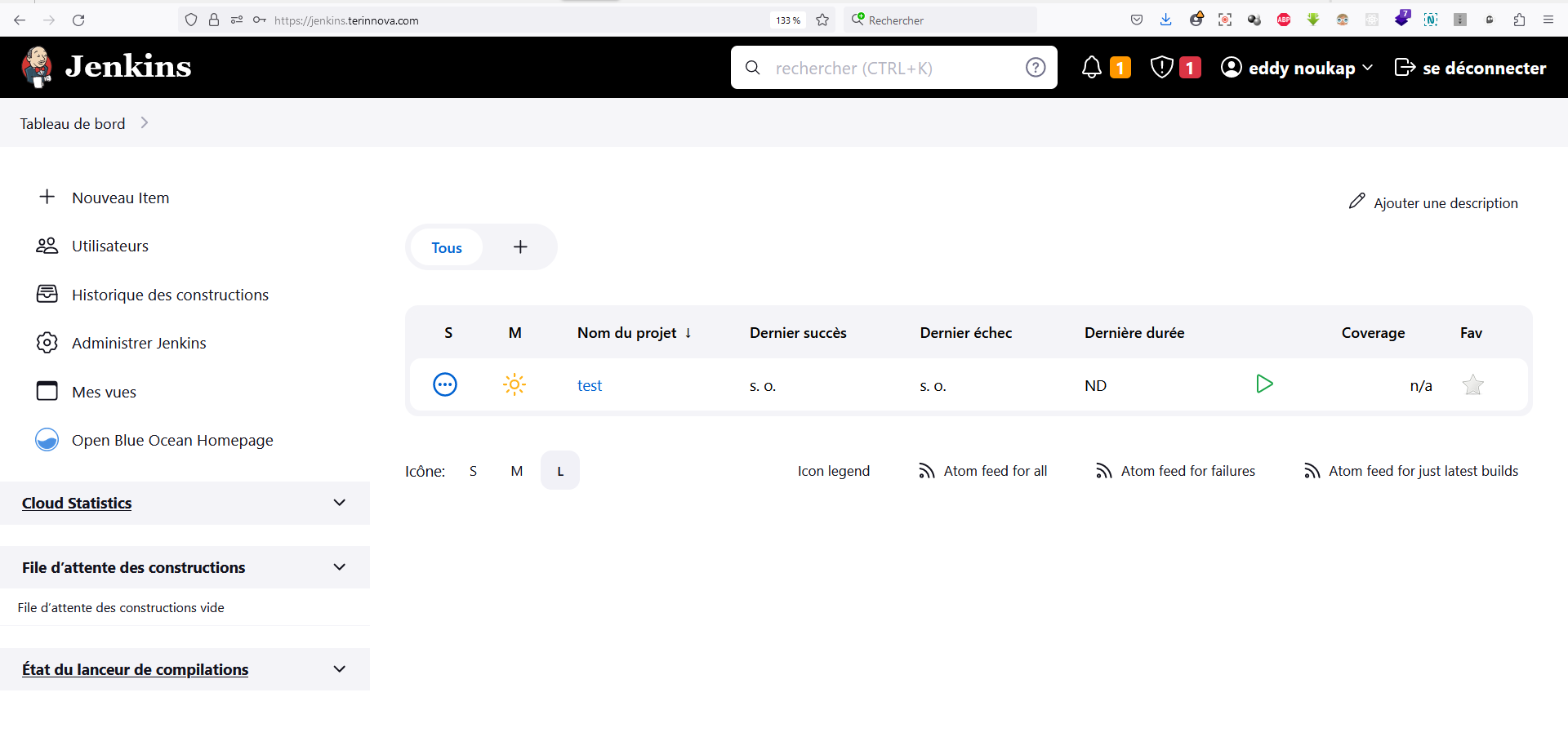
Installation de la chart helm
helm repo add jenkinsci https://charts.jenkins.io/
microk8s helm3 upgrade --install jenkins jenkinsci/jenkins -f values.yaml -n jenkins --version 4.4.1
Configuration de la chart helm
configuration du fichier values.yaml
values.yaml
  # The default configuration uses this secret to configure an admin user
  # If you don't need that user or use a different security realm then you can disable it
  adminSecret: true

  hostNetworking: false
  # When enabling LDAP or another non-Jenkins identity source, the built-in admin account will no longer exist.
  # If you disable the non-Jenkins identity store and instead use the Jenkins internal one,
  # you should revert controller.adminUser to your preferred admin user:
  adminUser: "terinnova-admin"
  # adminPassword: <defaults to random>
  admin:
    existingSecret: ""
    userKey: jenkins-admin-user
    passwordKey: jenkins-admin-password
  # This values should not be changed unless you use your custom image of jenkins or any devired from. If you want to use
  # Cloudbees Jenkins Distribution docker, you should set jenkinsHome: "/var/cloudbees-jenkins-distribution"
  jenkinsHome: "/var/jenkins_home"
  # This values should not be changed unless you use your custom image of jenkins or any devired from. If you want to use
  # Cloudbees Jenkins Distribution docker, you should set jenkinsRef: "/usr/share/cloudbees-jenkins-distribution/ref"
  jenkinsRef: "/usr/share/jenkins/ref"
  # Path to the jenkins war file which is used by jenkins-plugin-cli.
  jenkinsWar: "/usr/share/jenkins/jenkins.war"
  # Overrides the default arguments passed to the war
  # overrideArgs:
  #   - --httpPort=8080
  resources:
    requests:
      cpu: "50m"
      memory: "256Mi"
    limits:
      cpu: "2000m"
      memory: "4096Mi"
  # Share process namespace to allow sidecar containers to interact with processes in other containers in the same pod
  shareProcessNamespace: false
config installation de plugins
"values.yaml
  ...
  # List of plugins to be install during Jenkins controller start
  installPlugins:
    - kubernetes:3937.vd7b_82db_e347b_
    - workflow-aggregator:596.v8c21c963d92d
    - git:5.2.0
    - configuration-as-code:1647.ve39ca_b_829b_42
    - gitlab-plugin:1.7.14
    - docker-plugin:1.4
    - docker-commons:439.va_3cb_0a_6a_fb_29
    - docker-workflow:563.vd5d2e5c4007f
    - ansible:240.vc26740a_625c0
    - sonar:2.15
    - sonarqube-generic-coverage:1.0
    - blueocean:1.27.4
    - pipeline-stage-step:305.ve96d0205c1c6
    - pipeline-build-step:496.v2449a_9a_221f2
    - keycloak:2.3.2
    - oic-auth:2.6

  # Set to false to download the minimum required version of all dependencies.
  installLatestPlugins: true

  # Set to true to download latest dependencies of any plugin that is requested to have the latest version.
  installLatestSpecifiedPlugins: false
jenkins configuration as code
Si tu souhaites utiliser un fichier de configuration as code, alors il faut activer defaultConfig: true. puis dans le configmap qui sera crée dans kubernetes, tu peux coller le contenu de ton fichier de config as code puis redemarrer le deploiement jenkins.
values.yaml
  ...
  JCasC:
    defaultConfig: true
    configUrls: []
    # - https://acme.org/jenkins.yaml
    # Remote URL:s for configuration files.
    configScripts: {}
    #  welcome-message: |
    #    jenkins:
    #      systemMessage: Welcome to our CI\CD server.  This Jenkins is configured and managed 'as code'.
    # Allows adding to the top-level security JCasC section. For legacy,  default the chart includes apiToken configurations
    security:
      apiToken:
        creationOfLegacyTokenEnabled: false
        tokenGenerationOnCreationEnabled: false
        usageStatisticsEnabled: true
    # Ignored if securityRealm is defined in controller.JCasC.configScripts
    securityRealm: |-
      local:
        allowsSignup: false
        enableCaptcha: false
        users:
        - id: "${chart-admin-username}"
          name: "Jenkins Admin"
          password: "${chart-admin-password}"
    # Ignored if authorizationStrategy is defined in controller.JCasC.configScripts
    authorizationStrategy: |-
      loggedInUsersCanDoAnything:
        allowAnonymousRead: false
  # Optionally specify additional init-containers
  customInitContainers: []
  # - name: custom-init
  #   image: "alpine:3.7"
  #   imagePullPolicy: Always
  #   command: [ "uname", "-a" ]
config as code par default avec configuration de l'acces par OIDC avec keycloak
configAsCode-default.yaml
jenkins:
  agentProtocols:
  - "JNLP4-connect"
  - "Ping"
  authorizationStrategy:
    loggedInUsersCanDoAnything:
      allowAnonymousRead: false
  clouds:
  - kubernetes:
      containerCap: 10
      containerCapStr: "10"
      jenkinsTunnel: "jenkins-agent.jenkins.svc.cluster.local:50000"
      jenkinsUrl: "jenkins.terinnova.com"
      name: "kubernetes"
      namespace: "jenkins"
      podLabels:
      - key: "jenkins/jenkins-jenkins-agent"
        value: "true"
      serverUrl: "https://kubernetes.default"
      templates:
      - containers:
        - args: "^${computer.jnlpmac} ^${computer.name}"
          envVars:
          - envVar:
              key: "JENKINS_URL"
              value: "jenkins.terinnova.com"
          image: "jenkins/inbound-agent:3107.v665000b_51092-15"
          name: "jnlp"
          resourceLimitCpu: "512m"
          resourceLimitMemory: "512Mi"
          resourceRequestCpu: "512m"
          resourceRequestMemory: "512Mi"
          workingDir: "/home/jenkins/agent"
        id: "af336ddf87858dd02fb41a326ed9977da1515e635e70f86c32ff9ab887c9e8ae"
        label: "jenkins-jenkins-agent"
        name: "default"
        namespace: "jenkins"
        nodeUsageMode: NORMAL
        podRetention: "never"
        serviceAccount: "default"
        slaveConnectTimeout: 100
        slaveConnectTimeoutStr: "100"
        yamlMergeStrategy: "override"
  crumbIssuer:
    standard:
      excludeClientIPFromCrumb: true
  disableRememberMe: true
  labelAtoms:
  - name: "built-in"
  - name: "jenkins-jenkins-agent"
  markupFormatter: "plainText"
  mode: NORMAL
  myViewsTabBar: "standard"
  numExecutors: 0
  primaryView:
    all:
      name: "all"
  projectNamingStrategy: "standard"
  quietPeriod: 5
  remotingSecurity:
    enabled: true
  scmCheckoutRetryCount: 0
  securityRealm:
    oic:
      authorizationServerUrl: "https://keycloak.terinnova.com/auth/realms/terinnova/protocol/openid-connect/auth"
      automanualconfigure: "manual"
      clientId: "jenkins-id"
      clientSecret: "{AQAAABAAAAAwEawdIS4skvfFoq1A/HfCadpEKnaVNaH6TjKf8gknptlVIwTxAjjYnGC/0QXOyFmw1Mxubrq53sFzHroGAQk+2A==}"
      disableSslVerification: false
      emailFieldName: "email"
      endSessionEndpoint: "https://keycloak.terinnova.com/auth/realms/terinnova/protocol/openid-connect/logout"
      escapeHatchSecret: "{AQAAABAAAAAQ4clRSIIUbE+tC0Fz4U7ToAjoI1L7HN2cZ3OGkiPOKjU=}"
      fullNameFieldName: "name"
      groupsFieldName: "groups"
      postLogoutRedirectUrl: "https://jenkins.terinnova.com"
      scopes: "openid preferred_username"
      tokenAuthMethod: "client_secret_post"
      tokenServerUrl: "https://keycloak.terinnova.com/auth/realms/terinnova/protocol/openid-connect/token"
      userInfoServerUrl: "https://keycloak.terinnova.com/auth/realms/terinnova/protocol/openid-connect/userinfo"
      userNameField: "preferred_username"
  slaveAgentPort: 50000
  updateCenter:
    sites:
    - id: "default"
      url: "https://updates.jenkins.io/update-center.json"
  views:
  - all:
      name: "all"
  viewsTabBar: "standard"
globalCredentialsConfiguration:
  configuration:
    providerFilter: "none"
    typeFilter: "none"
security:
  apiToken:
    creationOfLegacyTokenEnabled: false
    tokenGenerationOnCreationEnabled: false
    usageStatisticsEnabled: true
  gitHooks:
    allowedOnAgents: false
    allowedOnController: false
  gitHostKeyVerificationConfiguration:
    sshHostKeyVerificationStrategy: "knownHostsFileVerificationStrategy"
  sSHD:
    port: -1
unclassified:
  bitbucketEndpointConfiguration:
    endpoints:
    - bitbucketCloudEndpoint:
        enableCache: false
        manageHooks: false
        repositoriesCacheDuration: 0
        teamCacheDuration: 0
  buildDiscarders:
    configuredBuildDiscarders:
    - "jobBuildDiscarder"
  fingerprints:
    fingerprintCleanupDisabled: false
    storage: "file"
  gitHubConfiguration:
    apiRateLimitChecker: ThrottleForNormalize
  gitHubPluginConfig:
    hookUrl: "https://jenkins.terinnova.com/github-webhook/"
  gitLabConnectionConfig:
    connections:
    - clientBuilderId: "autodetect"
      connectionTimeout: 10
      ignoreCertificateErrors: false
      readTimeout: 10
    useAuthenticatedEndpoint: true
  junitTestResultStorage:
    storage: "file"
  location:
    adminAddress: "Adresse pas encore configurée <nobody@nowhere>"
    url: "https://jenkins.terinnova.com/"
  mailer:
    charset: "UTF-8"
    useSsl: false
    useTls: false
  pollSCM:
    pollingThreadCount: 10
  prismConfiguration:
    theme: PRISM
  scmGit:
    addGitTagAction: false
    allowSecondFetch: false
    createAccountBasedOnEmail: false
    disableGitToolChooser: false
    hideCredentials: false
    showEntireCommitSummaryInChanges: false
    useExistingAccountWithSameEmail: false
  sonarGlobalConfiguration:
    buildWrapperEnabled: false
tool:
  git:
    installations:
    - home: "git"
      name: "Default"
  mavenGlobalConfig:
    globalSettingsProvider: "standard"
    settingsProvider: "standard"
config ingress
values.yaml
  ...
  ingress:
    enabled: true
    # Override for the default paths that map requests to the backend
    paths: []
    # - backend:
    #     serviceName: ssl-redirect
    #     servicePort: use-annotation
    # - backend:
    #     serviceName: >-
    #       {{ template "jenkins.fullname" . }}
    #     # Don't use string here, use only integer value!
    #     servicePort: 8080
    # For Kubernetes v1.14+, use 'networking.k8s.io/v1beta1'
    # For Kubernetes v1.19+, use 'networking.k8s.io/v1'
    apiVersion: "networking.k8s.io/v1"
    labels:
      app: jenkins
    annotations:
      kubernetes.io/ingress.class: nginx
      kubernetes.io/tls-acme: "true"
      cert-manager.io/cluster-issuer: letsencrypt
    # For Kubernetes >= 1.18 you should specify the ingress-controller via the field ingressClassName
    # See https://kubernetes.io/blog/2020/04/02/improvements-to-the-ingress-api-in-kubernetes-1.18/#specifying-the-class-of-an-ingress
    # ingressClassName: nginx
    # Set this path to jenkinsUriPrefix above or use annotations to rewrite path
    path: "/"
    # configures the hostname e.g. jenkins.example.com
    hostName: jenkins.terinnova.com
    tls:
      - secretName: jenkins-letsencrypt
        hosts:
          - jenkins.terinnova.com
configuration l'agent jenkins
values.yaml
...
agent:
  enabled: true
  defaultsProviderTemplate: ""
  # URL for connecting to the Jenkins controller
  jenkinsUrl: jenkins.terinnova.com
  # connect to the specified host and port, instead of connecting directly to the Jenkins controller
  jenkinsTunnel:
  kubernetesConnectTimeout: 5
  kubernetesReadTimeout: 15
  maxRequestsPerHostStr: "32"
  namespace:
  # private registry for agent image
  jnlpregistry:
  image: "jenkins/inbound-agent"
  tag: "3107.v665000b_51092-15"
  workingDir: "/home/jenkins/agent"
  nodeUsageMode: "NORMAL"
  customJenkinsLabels: []
  # name of the secret to be used for image pulling
  imagePullSecretName:
  componentName: "jenkins-agent"
  websocket: false
  directConnection: false
  privileged: false
  runAsUser:
  runAsGroup:
  hostNetworking: false
  resources:
    requests:
      cpu: "512m"
      memory: "512Mi"
    limits:
      cpu: "512m"
      memory: "512Mi"
  livenessProbe: {}
config persistent volume
values.yaml
...
persistence:
  enabled: true
  ## A manually managed Persistent Volume and Claim
  ## Requires persistence.enabled: true
  ## If defined, PVC must be created manually before volume will be bound
  existingClaim:
  ## jenkins data Persistent Volume Storage Class
  ## If defined, storageClassName: <storageClass>
  ## If set to "-", storageClassName: "", which disables dynamic provisioning
  ## If undefined (the default) or set to null, no storageClassName spec is
  ##   set, choosing the default provisioner.  (gp2 on AWS, standard on
  ##   GKE, AWS & OpenStack)
  ##
  storageClass:
  annotations: {}
  labels: {}
  accessMode: "ReadWriteOnce"
  size: "100Gi"
  volumes:
  #  - name: nothing
  #    emptyDir: {}
  mounts:
  #  - mountPath: /var/nothing
  #    name: nothing
  #    readOnly: true